Shanghai and Nanjing 1937: Massacre on the Yangtze (Campaign) by Benjamin Lai
Author:Benjamin Lai [Lai, Benjamin]
Language: eng
Format: azw3
ISBN: 9781472817518
Publisher: Bloomsbury Publishing
Published: 2017-06-29T04:00:00+00:00
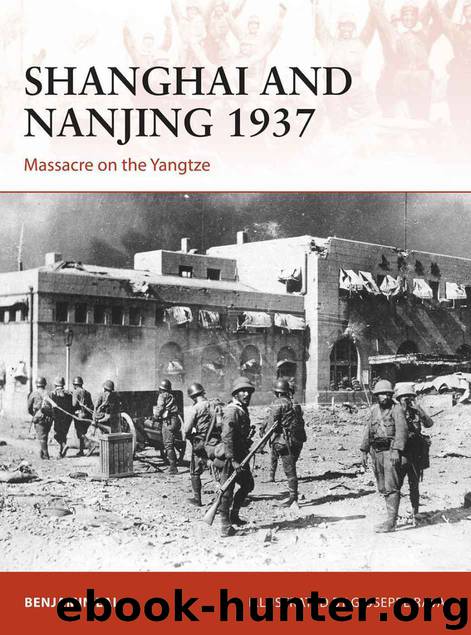
Japanese infantrymen hauling a Type 41 mountain gun at the heavily contested Shanghai North Railway Station, where the elite ‘Germanized’ Chinese troops were once based. (Getty Images 79666179)
During late September, the lines stabilized, and from their dug-in positions the Chinese fought a defensive battle, in which they excelled. Despite the Chinese having superiority in numbers with the addition of the 15th, 32nd, 57th and 77th divisions along with IV and LXVI Corps, by using their superior firepower, the Japanese were still able to make some advances, albeit at a high cost. Some of the Japanese losses were of their own making; the Shigeto Detachment, having landed full of gusto, were to lose 200 men in a single skirmish for little gain – they did receive a scolding from Matsui for their pains. On the 25th, in order to tighten the defensive line, and to eliminate the dangerous dog’s leg, Chen ordered a tactical withdrawal and withdrew 2km to the rear. The withdrawal was done in perfect order, and it was another two days before the Japanese realized what had happened.
With the additional forces in place, Matsui felt that he could now take to the offensive and drive the Chinese from Shanghai by a giant right hook. His aim was to switch the axis of advance from west to south, pushing his forces across Wusong Creek Wu Song He 13 and eventually to Suzhou Creek, the northern boundary of the International Settlement. Matsui gave his order on 29 September with Dachang as the main objective. He placed the 9th Division on the right, the 3rd in the centre and the 101st to the left, with the 11th Division as the rear guard and holding the northern flank against an attack from the west. The 13th Division was held in reserve. The attack began on 1 October, but with the two armies still engaging in see-saw battles, the positions changed hands five times on this day. On 17 October, the ‘Gui’ (Guangxi Province in South-West China) clique 21st Army Group (consisting of two corps, containing the 171st, 173rd, 174th and 176th divisions, under Central Sector command and deployed around Zoumatang Creek 走马塘河) under General Li Zongren 李宗仁, finally arrived. The ‘Gui’ troops were easily distinguished from the ‘German’ Central Army by their British-style helmets. With this additional force, Chiang staged a final counteroffensive, based on a plan crafted by Bai Chongxi, his military advisor. However, like the many other orchestrated offensives, this one was also marred by poor planning and coordination, which limited its chances of success even before the start of the battle. The lack of staff officers was one reason why. Often little or no information was available on the enemy, because little or no reconnaissance had been carried out; poor logistics meant there were insufficient river-crossing capabilities; knowing that many creeks were in the area, the German advisors were constantly perplexed by the Chinese decision to rush troops into battle without adequate battle preparation. Combined with poor preparation and
Download
This site does not store any files on its server. We only index and link to content provided by other sites. Please contact the content providers to delete copyright contents if any and email us, we'll remove relevant links or contents immediately.
| Africa | Americas |
| Arctic & Antarctica | Asia |
| Australia & Oceania | Europe |
| Middle East | Russia |
| United States | World |
| Ancient Civilizations | Military |
| Historical Study & Educational Resources |
The Sympathizer by Viet Thanh Nguyen(4398)
The Rape of Nanking by Iris Chang(4224)
World without end by Ken Follett(3481)
Ants Among Elephants by Sujatha Gidla(3470)
Blood and Sand by Alex Von Tunzelmann(3207)
Japanese Design by Patricia J. Graham(3183)
The Queen of Nothing by Holly Black(2606)
City of Djinns: a year in Delhi by William Dalrymple(2561)
Foreign Devils on the Silk Road: The Search for the Lost Treasures of Central Asia by Peter Hopkirk(2469)
India's Ancient Past by R.S. Sharma(2462)
Inglorious Empire by Shashi Tharoor(2445)
Tokyo by Rob Goss(2435)
In Order to Live: A North Korean Girl's Journey to Freedom by Yeonmi Park(2394)
Tokyo Geek's Guide: Manga, Anime, Gaming, Cosplay, Toys, Idols & More - The Ultimate Guide to Japan's Otaku Culture by Simone Gianni(2377)
India's biggest cover-up by Dhar Anuj(2359)
The Great Game: On Secret Service in High Asia by Peter Hopkirk(2354)
Goodbye Madame Butterfly(2258)
Batik by Rudolf Smend(2190)
Living Silence in Burma by Christina Fink(2074)
